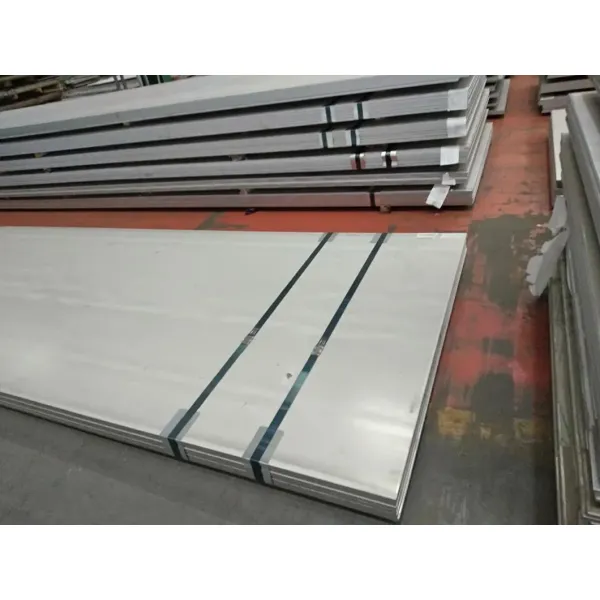
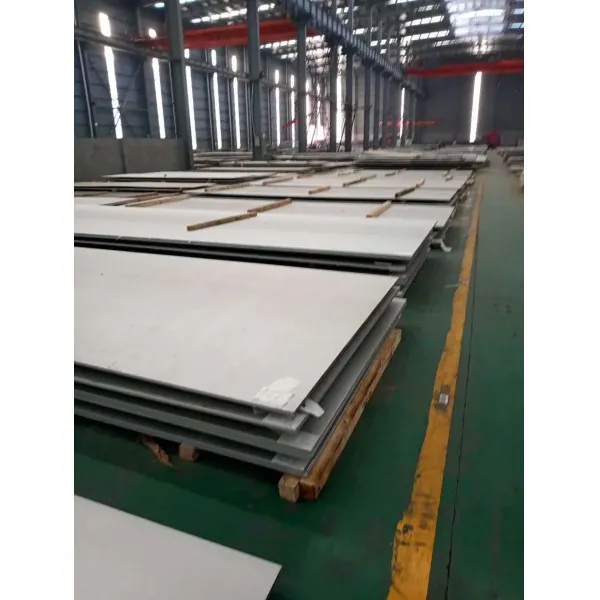
Anti-Finger Print Stainless Steel Sheet Grade 430 No. 4 Hairline 8K Finish with PVC Film
Anti-finger Print Stainless Steel Sheet Grade 430 NO.4 Hairline 8K Finish With PVC Film
Specification of 430 Stainless Steel
| Products |
430 Stainless Steel Sheet |
| Thickness |
Cold rolled 0.3 - 3.0mm
Hot rolled 3.0 - 10.0mm |
| Standard Size |
Cold rolled 1000*2000mm 1219*2438mm
Hot rolled 1500*6000mm |
| Surface |
2B BA NO.4 Hairline Mirror 8K .etc |
| Brand |
TISCO JISCO POSCO BAOSTEEL |
| Standard |
ASTM A240 / JIS G4305 / EN 10088-2 |
| Other Grade |
201 202 301 304 304L 309S 310S 316L 316Ti 317L 321 347 410 420 430 440 441 443 444 2205 2507.etc |
| Our Service |
Slit Cutting, Surface process |
Introduction of 430 Stainless Steel
Stainless steel grade 430 is a non-hardenable steel containing straight chromium, and belongs to the ferritic group of steels. This steel is known for its good corrosion resistance and formability, coupled with practical mechanical properties. It can be used in certain chemical applications.
Grade 430F stainless steel is usually provided in bar form to be used in automatic screw machines.
Grade 434 has similar properties as grade 430, although it is a molybdenum-bearing version. The molybdenum content enhances its corrosion resistance.
Key Properties
The following sections provide the key properties of grade 430 stainless steels coil, sheet and plate - covered under ASTM A240/A240M.
Composition of 430 Stainless Steel
Chemical compositions of grade 430 stainless steels:
| Grade |
C |
Mn |
Si |
P |
S |
Cr |
Mo |
Ni |
N |
| 430 |
- 0.12 |
- 1 |
- 1 |
- 0.04 |
- 0.030 |
16 18 |
- |
- 0.50 |
- |
| 430F |
- 0.12 |
- 1.25 |
- 1 |
- 0.06 |
0.15 - |
16 18 |
- |
- |
- |
Mechanical Properties of 430 Stainless Steel
| Grade |
Tensile Strength (MPa) min |
Yield Strength 0.2% Proof (MPa) min |
Elongation (% in 50mm) min |
Hardness Rockwell B (HR B) max |
Hardness Brinell (HB) max |
| 430 |
483 |
310 |
22 |
85 |
183 |
| 430F |
552 typical |
379 typical |
25 typical |
- |
262 |
Physical Properties of 430 Stainless Steel
| Grade |
Density (kg/m³) |
Elastic Modulus (GPa) |
Mean Coefficient of Thermal Expansion (μm/m/°C) |
Thermal Conductivity (W/m.K) |
Specific Heat 0-100°C (J/kg.K) |
Electrical Resistivity (nΩ.m) |
| 430 |
7750 |
200 |
10.4 |
26.1 |
460 |
600 |
| 430F |
7750 |
200 |
10.4 |
26.1 |
460 |
600 |
Grade Specification Comparison
| Grade |
UNS No |
Old British |
Euronorm |
Swedish SS |
Japanese JIS |
| 430 |
S43000 |
430S17 |
1.4016 |
2320 |
SUS 430 |
| 430F |
S43020 |
- |
1.4104 |
2383 |
SUS 430F |
Possible Alternative Grades
| Grade |
Reasons for choosing 430 |
| 430F |
Higher machinability than 430 is needed in bar product, and reduced corrosion resistance is acceptable |
| 434 |
Better pitting resistance is required |
| 304 |
Slightly higher corrosion resistance is needed, together with greatly improved ability to be welded and cold formed |
| 316 |
Much better corrosion resistance is needed, coupled with greatly improved ability to be welded and cold formed |
| 3CR12 |
Lower corrosion resistance is acceptable in a cost-critical application |
Corrosion Resistance
All ferritic grades, such as stainless steel grade 430, have excellent stress corrosion cracking resistance. Grade 430 has good corrosion resistance to numerous substances. The corrosion resistance is maximized in well-polished or buffed condition. Its pitting and crevice corrosion resistance is quite similar to that of grade 304. 430F is a high-sulfur free machining grade, and therefore the resistance to pitting and crevice corrosion is comparatively lesser than those grades that are non-free machining.
Heat Resistance
Stainless steel grade 430 is capable of resisting oxidation up to 870°C (1598°F) in intermittent usage, and up to 815°C (1499°F) in continuous usage. At room temperature, it has the tendency to become brittle, especially when it has been heated for a long time in the 400-600°C (752-1112°F) range. This issue can be overcome with annealing.
Heat Treatment
Solution annealing can be performed by heating stainless steel grade 430 to 815 - 845°C (1499-1553°F). Then it has to be slow furnace cooled to 600°C (1112°F) and followed by air-cooling in a quick manner - as slow cooling between 540 and 400°C (1004 and 752°F) tends to cause embrittlement.
For sub-critical annealing, heating should be performed to 760-815°C (1400-1499°F), followed by air-cooling or water quenching.
This stainless steel cannot be hardened by thermal treatment.
Welding
To perform any welding, stainless steel grade 430 has to be pre-heated at 150-200°C (302-392°F). In case of embrittlement in the welded metal, the particular area can be post-weld annealed at 790-815°C (1454-1499°F); however grain refinement will not happen.
It is recommended that grade 430, 308L, 309 or 310 filler rod should be used based on the application.
Machining
The machinability of stainless steel grade 430 is a lot easier than standard austenitic steels such as grade 304 - but there is a chance for galling. Lightly drawn bars are easier to machine than bars in the annealed condition. Grade 430F is easy to machine.
Fabrication
Stainless steel grade 430 has a low work hardening rate which enables easy bending and forming. The low ductility rate, however, makes it difficult to perform very rigorous operations. It is possible for grade 430 wire to handle rigorous cold heading. Sub-critical intermediate annealing may be required for extreme cold working.
Applications of 430 Stainless Steel
- Dish washer linings
- Refrigerator cabinet panels
- Element supports and fasteners
- Stove trim rings and chimney liners
- Automotive trim and lashing wires
Product Photos